Showing posts with label Barbican. Show all posts

Friday, June 3, 2011

When the concept overpowers the words

As a performer and director, I treat the play-text with the greatest respect. I love style, heightened acting, visual feasts, hybrid forms, colours, lights, sounds, textures, etc etc - but if these things don't compliment the text (especially one that's been around a while) then I too feel disconnected from the experience. And that is exactly how I felt in Deborah Warner's re-imagining of Sheridan's classic comedy The School for Scandal at the Barbican.

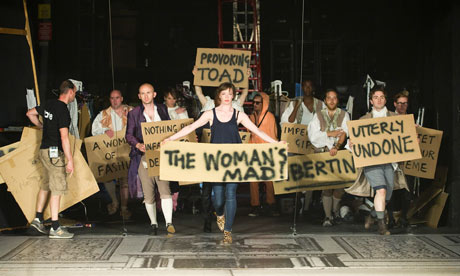
Sheridan's beloved comedy on Georgian social mores is often difficult to produce. It's wit, although sharp, is specific to 18th century comedy and many contemporary productions go overboard in trying to re-align the text to contemporary concerns and anxieties. But I don't think a complete re-invention of the text is necessary. It's a charming look at gossip and the keeping up with the Jones' mentality of the upper echelons of society - they're vulgar, self-centered, and shallow - and yet some are redemptive and likeable nonetheless. Warner's production is a bold attempt to bring the classic into the 21st century - mixing Georgian and contemporary styles with a Brechtian structure of movable/foldable sets, showing us the workings of stage. It's visually stunning and playful (to the point of absurdity) but the muddy concept overpowers the words and thus the characters.

Costumes mix together Georgian corsets with modern tights, buckle shoes and sneakers, ripped jeans and 18th century wigs. Cell phones and coke (both the drug and the drink) make appearances. It's as if Warner is shouting "look how relevant this is to today's world!!!"

There's nothing consistent about this production. Sheridan wrote in a simpler time. Many of today's theatre is shrouded with contemporary society's anxiety of the information age where everything is at our fingertips. Sometimes we try to overcompensate as today's world is fast and confusing as new information flows faster and faster. It's hard to keep up. Warner's production embodies this uneasiness which is why is simply doesn't work with Sheridan's assured text. Even generational differences are shown through the acting styles - adding to the confusion of the direction. The older actors are calm and confident in their characters and delivery of the text - they are subtle, clear and lovely.

I believe in being bold as a director. But I also think sometimes the boldest choice is keeping it simple. I loved the visual blurring of Georgian and contemporary styles, I also loved the set (but not for this production) but overall the concept overpowered the text. The acting (although strong all around) was not consistent nor apart of the same world. It was filled with over zealousness and lacked humanity. Breathing new life into an old story is one thing, but if you want to completely re-invent a classic then just write a new story. Also, trust your audience. I felt as if I was being coddled at times - again that has to go with the "look how relevant this old play is!" concept. When it comes to the classics, simply good story telling will suffice. Trust the words. Make them come to life.

Monday, May 30, 2011

Idiots on Horses

Ok so this is another ridiculously late post (May was all consuming!)  I saw this hilarious show back in the beginning of May at the Barbican, I definitely want to see more from the absurdly creative group Told by an Idiot.


I don't think I've ever seen anything so absurd before. There's a whole lotta WTH is happening here? We Have Hitchcock, Acrobats, Louis IVX, a department store, monkeys, bugs bunny, the Alps, dogs lit on fire, and bombs. The quintet ensemble masterfully switch from scene to scene, character to character. Although I must admit I was a bit lost in the beginning (I went into it not knowing anything about the play nor the company), once they got past the multiple story lines set-up I was able to follow along.

The interweaving story lines become darker and darker throughout but the charm and characterizations keep it funny - well, absurd really. It's only later does one realize the implications of laughing at extremism. My favorite sequence follows a family of acrobats traveling through the Alps to France on the request of Louis IVX. They find a crevasse and after chopping down a tree the family one by one cross over. Sadly, one of the members falls to his death. Cue melodramatic music:  A passing around of his hat as they all mourn his death with great over-emphasis. It's hysterical. Which is horrible. A wind storm comes and they struggle - with pure comedic eagerness - up the Alps. Unfortunately, one is blown off the mountain. Cue melodramatic music:  A passing around of her hat as they all mourn her death with great over-emphasis. Again, it's hysterical. Which, again, is horrible.

As amusing as the performances are, the dark comedy and suspense melodrama hybrid never quite reaches its full potency - partly due to the sketch comedic structure. They are working with a highly charged topic of the dangers of extremism (under the motto Enlightenment by Demonstration) and I don't think they quite succeeded in delivering that message. That being said, the sheer bravado of the ensemble is enough to keep you engaged. Watching them, I kept thinking to myself, "I want to play with them!"

This show is another example of contemporary society's preoccupation with apocalyptic anxieties. We are our own worst enemies. The Enlightenment by Demonstration conceit shows us that sometimes there's no stopping our self destructive actions.

Saturday, February 5, 2011

When film and stage collide: The Antonioni Project

After hearing about the legendary 6-hour performance of The Roman Tragedies based on Shakespeare's Coriolanus, Julius Caesar, and Antony and Cleopatra by the Dutch theatre company Toneelgroep Amsterdam I was eager to see their latest at the Barbican, The Antonioni Project - based on Italian auteur Michelangelo Antonioni’s 1960s films, L’Avventura, La Notte and L’Eclisse.

I mistakenly went to the performance without reading up or watching anything on Antonioni's films. I found the three converging story lines confusing and at some points trite. Thus, I cannot speak in depth on whether or not their examination on Antonioni's film is successful, for lack of a better word, or not. So here are my initial reactions to the piece.

The enormous Barbican Theatre stage is transformed into a Hollywood studio blue box (used for CGI effects) with a screen on the upper half of the proscenium (complete with subtitles for those of us who don't speak Dutch), cameras set up on stage, a film track for tracking shots, and the "orchestra pit" is set up with tv's and technicians as well as couches where the actors sit. As you can tell from this initial description, a lot is going on.

Although the undertaking is commendable I'm left not entirely satisfied. Perhaps it is the two-dimensional characters, my ADHD (seriously, A LOT is happening on stage all at once), or my recent longing for simplicity. A part of me is wondering where theatre is going as we begin to incorporate and rely on more and more technology. My fear is that use of technology, our post post-modern self-reflexivity and a growing sensation of an existential void are going to try to eradicate good old fashioned story telling.

Putting my nostalgia aside, however, I honestly found the performance fascinating. And there were some stunning moments of longing, connection and vulnerability - but nothing substantial enough to grasp on to. The visual elements are intriguing as we watch the actors in the blue on stage and the filmic close-up on screen. And transitions between cuts are thoughtful act actors flow between each other, mimicking the dissolve editing in film. 

The acting, tinged with a bit of 1960s melodrama, is constant and committed throughout which makes the lack of character depth not as much of an issue, especially because I don't think we're supposed to have any connections to any of the characters, nor are we to identify with them; and if we do identify with them, we should take a seriously look at ourselves. By the middle of the second act everyone is hooking up, one couple brilliantly stumble around the stage tearing at each other. As the characters continue to make what my friends and I call "life mistakes" one can't help be feel a little depressed. And my one, I am obviously referring to myself. I could go into detail, but that's way more information than I'm willing to reveal here.


Here's a clip from the show:

Antonioni Project from Tal Yarden on Vimeo.

Here's an American trailer for L'Avventura:


La Notte:


L'Eclisse:


Having now watched a few clips and documentaries on Antonioni, Toneelgroep definitely captures his characters' materialistic worlds and their inability to connect, however I don't feel the languidness on the stage as I do the films. I don't sense a search for meaning from the creators like I do from Antonioni. What I get is a lot more frenetic and complicated, which is perhaps where my hesitation is in fully embracing this piece.

Monday, January 31, 2011

Laugh @ Sadler's Wells and Goudron et des Plumes @ Barbican Theatre

Antonia Baehr's Laugh at Sadler's Wells is 70 minutes of her, well, laughing. The German choreographer, director and performer asked friends to write a "score" of laughter for her birthday. She begins by treating the event like a concert, with the names of the "composers" projected for each piece, and afterwards, dressed in a man's suit with brown shoes and slicked back hair she bows with the utmost seriousness.

There's one where she traces out a triangle in the air keeping the tempo like a metronome. point-point-ha, point-ha-ha, point-ha-chortle, etc until she's fighting to keep the triangle going as she laughs, coughs and gasps for air. The control and endurance is astounding. Having done clowning and laughing exercises, I understand exactly what is necessary to control that oftentimes uncontrollable muscle - and over an hour it's certainly a feat. A clever score that I would love to use as a training exercise uses a variety of balls, the laugh matching the quality of sound of the ball as it bounces and rolls. She then uses multiple balls and expertly traces their sound with laughter.

My favorite, which most of my classmates found terrifying, is where she stand behinds a magnifying glass (see picture). What starts of humorous in itself as she appears to have a ginormous head and little body, she laughs and giggles and flutters around in a circle; the silliness gradually grows into a maniacal cackle, escalated by an echoing amplification. I was crying with laughter - I've never seen anything so silly, absurd and terrifyingly delightful.

Something charming are the "scores" from her parents. Her mother wanted to record a session of them together, wanting her daughter to explain why she was doing this. "You can't fake laughter," says her mother in German, "it's not authentic and not contagious." Baehr then immediately laughs for her mother, who in turn laughs back at her daughter. "See, definitely not contagious." Ha! Her father's score was a request that she record and compare her family's laughs and then compose them into Beethoven''s symphony (or something like that?) Equipped with a mixer she mixes the laughs of her, her parents and uncle into a rhythmic beat.

All in all, I found it an interesting experiment on laughter and I appreciate Baehr's skill and stage presence throughout the piece.


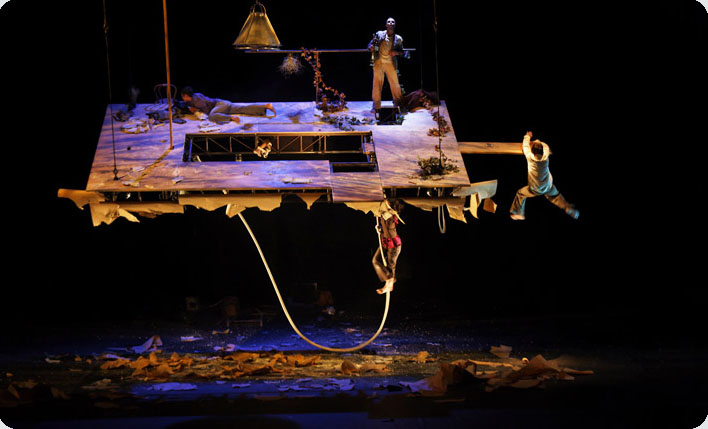
Over at the Barbican (which is quickly becoming one of my favorite venues) I saw Du Goudron et Des Plumes, part of the London International Mime Festival, which is a 75 minute brilliant acrobatic exploration set on a high flying raft brought to us with the expert and stunning skill of the French  Compagnie MPTA and choreographer Mathurin Bolze.

The five performers (four guys and a lady) begin in stillness, and then slowly emerge from and explore their raft, bouncing, jumping, swinging, climbing from it's boards and wires. The raft sways as one performer balances and jumps on a plank. Tableaux in motion flash as the rhythmic swaying raft represents the passing of time. For one humourous scene the performers recreate a reflection down below from what's happening up top. The guy upside down desperately fights gravity and ends up with water in the face (and old school clown gag). Another scene they roll down sheets of paper off the raft and create shadows and image tricks with lights. Some of it seems gratuitous, but towards the end of that scene it was riveting. They then chop down the paper in madness as the woman jumps off the raft. The men go nuts and start destroying everything in a frenzy. The woman, now on a rope dangling below, twists and turns in the air. Finally the raft tilts down and the members of the raft slip and slid and hang on for dear life. The raft eventually finds land and it's inhabitants slowly emerge from the vessel for an enthusiastic applause.

The pacing is nice, keeping the audience engaged and also allowing time for the performers to rotate seamlessly to rest. The sound is stunning and matches the action perfectly. I've never seen anything like this: a mixture of acrobatics, mime, clown, and physical theatre - the theatrics of this event are completely stunning and captivating and it all looked effortless by the immensely skilled performers.

Tuesday, October 19, 2010

I visited The Country, went to Hell's Half Acre and ended up at T.E.O.R.E.M.A.T.

This post is a little late as I've been very busy being lazy and procrastinating so now I've had to catch up on school work. Sometimes I forget that I'm in London to get my masters, not to just see shows.

Last week Monday two of my classmates and I saw The Country by Martin Crimp playing at the Arcola Theatre in Hackney. It went off to a smashing start as Joe and I got lost - thankfully I was able to call Jane and have her give us directions. Then we sped-walked to the theatre.

The Arcola is a wonderful space. As we walked into the theatre there were trees and pebbles all over the floor; the seating set up in the round. As we walked in, I said to my friends, "I like this already." Set up in the round the design is both simplistic and infused with symbolism. Anna Bliss Scully’s design with it's deteriorating layers of wood flooring, a stove, telephone, bench, and table an chair - and the trees surrounding the audience, magnifies the isolation of the country.

The play chronicles the relationship of Richard, a doctor, and his wife Corinne after he brings home a strange woman, Rebecca, whom he claims to have found passed out on the side of the road. Crimp's use of language is evocative and eerily unsettling. It took me some time to settle in to the repetitive and quizzical dialogue - but once I did, I was absolutely transfixed. That is until the character Rebecca comes out. Crimp has written the character as an American (why, I don't know) and I have to say that the accent was terrible. I took me completely out of the experience. Although Naomi Wattis had great characterization and physicalization - and it was apparent she understood the text - her accent was quite baffling. That being said, overall I found the production to be well done with Amelia Nicholson's to-the-point direction and smart staging. Simon Thorp as the doctor with too many secrets does especially well portraying a man struggling to keep control and has pitch-perfect black-comedic timing. Amanda Root, however, shines as the exasperated, albeit controlled, wife. Her big eyes somehow manage to simultaneously hide and reveal everything.

This being my first exposure to Crimp - I'd love to read and see more of his work.

Here's a teaser trailor of the play:


Friday night I went to see an art installation called Hell's Half Acre in the Old Vic Tunnels by Lazarides galleries with my fellow American, Rachel. The installation is based on Dante's Inferno. There were some wickedly awesome paintings, sculptures, videos and photos.

Here are some pics:


Sunday I saw T.E.O.R.E.M.A.T.  by the Polish company TR Warszawa at the Barbican. This stunning production inspired by Italian poet, writer and activist Pier Paolo Pasolini and his film Teorema is grippingly absurd as it depicts five family members and their sexual interaction with a young man who comes to stay with them. Although there were points where I was wondering what the hell was happening, the visual styling and sensual acting were superb. The play begins with the patriarch at center stage behind a desk who is questioned by members of the audience. The last question being, "Do you believe in God?" His reply, "I don't understand the question."

Then the style and pace changes dramatically. The large stage is fully utilized as each member occupies their given space. The patriarch at his desk, working; the mother at her boudoir delecatley putting on her makes up; the son and daughter the the mirror getting ready for the day; and the maid going about her duties. The daily routine is played slowly and deliberately - and they do variations of this three times. The rest of the scenes pick up the pace with the introduction of the stranger who seduces each member and then departs just a quickly as he arrived.

Superbly acted, along with a viscerally stunning score, this experimental mode of story telling makes me long to see more work by this evocative company.