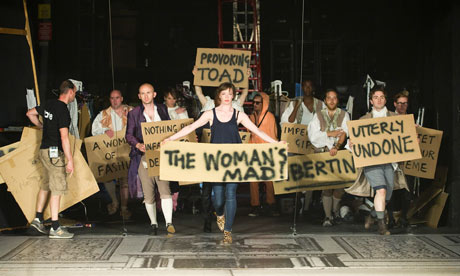
As a performer and director, I treat the play-text with the greatest respect. I love style, heightened acting, visual feasts, hybrid forms, colours, lights, sounds, textures, etc etc - but if these things don't compliment the text (especially one that's been around a while) then I too feel disconnected from the experience. And that is exactly how I felt in Deborah Warner's re-imagining of Sheridan's classic comedy The School for Scandal at the Barbican.
Sheridan's beloved comedy on Georgian social mores is often difficult to produce. It's wit, although sharp, is specific to 18th century comedy and many contemporary productions go overboard in trying to re-align the text to contemporary concerns and anxieties. But I don't think a complete re-invention of the text is necessary. It's a charming look at gossip and the keeping up with the Jones' mentality of the upper echelons of society - they're vulgar, self-centered, and shallow - and yet some are redemptive and likeable nonetheless. Warner's production is a bold attempt to bring the classic into the 21st century - mixing Georgian and contemporary styles with a Brechtian structure of movable/foldable sets, showing us the workings of stage. It's visually stunning and playful (to the point of absurdity) but the muddy concept overpowers the words and thus the characters.
Costumes mix together Georgian corsets with modern tights, buckle shoes and sneakers, ripped jeans and 18th century wigs. Cell phones and coke (both the drug and the drink) make appearances. It's as if Warner is shouting "look how relevant this is to today's world!!!"
There's nothing consistent about this production. Sheridan wrote in a simpler time. Many of today's theatre is shrouded with contemporary society's anxiety of the information age where everything is at our fingertips. Sometimes we try to overcompensate as today's world is fast and confusing as new information flows faster and faster. It's hard to keep up. Warner's production embodies this uneasiness which is why is simply doesn't work with Sheridan's assured text. Even generational differences are shown through the acting styles - adding to the confusion of the direction. The older actors are calm and confident in their characters and delivery of the text - they are subtle, clear and lovely.
I believe in being bold as a director. But I also think sometimes the boldest choice is keeping it simple. I loved the visual blurring of Georgian and contemporary styles, I also loved the set (but not for this production) but overall the concept overpowered the text. The acting (although strong all around) was not consistent nor apart of the same world. It was filled with over zealousness and lacked humanity. Breathing new life into an old story is one thing, but if you want to completely re-invent a classic then just write a new story. Also, trust your audience. I felt as if I was being coddled at times - again that has to go with the "look how relevant this old play is!" concept. When it comes to the classics, simply good story telling will suffice. Trust the words. Make them come to life.
Friday, June 3, 2011
Monday, May 30, 2011
Idiots on Horses
Ok so this is another ridiculously late post (May was all consuming!) I saw this hilarious show back in the beginning of May at the Barbican, I definitely want to see more from the absurdly creative group Told by an Idiot.
I don't think I've ever seen anything so absurd before. There's a whole lotta WTH is happening here? We Have Hitchcock, Acrobats, Louis IVX, a department store, monkeys, bugs bunny, the Alps, dogs lit on fire, and bombs. The quintet ensemble masterfully switch from scene to scene, character to character. Although I must admit I was a bit lost in the beginning (I went into it not knowing anything about the play nor the company), once they got past the multiple story lines set-up I was able to follow along.
The interweaving story lines become darker and darker throughout but the charm and characterizations keep it funny - well, absurd really. It's only later does one realize the implications of laughing at extremism. My favorite sequence follows a family of acrobats traveling through the Alps to France on the request of Louis IVX. They find a crevasse and after chopping down a tree the family one by one cross over. Sadly, one of the members falls to his death. Cue melodramatic music: A passing around of his hat as they all mourn his death with great over-emphasis. It's hysterical. Which is horrible. A wind storm comes and they struggle - with pure comedic eagerness - up the Alps. Unfortunately, one is blown off the mountain. Cue melodramatic music: A passing around of her hat as they all mourn her death with great over-emphasis. Again, it's hysterical. Which, again, is horrible.
As amusing as the performances are, the dark comedy and suspense melodrama hybrid never quite reaches its full potency - partly due to the sketch comedic structure. They are working with a highly charged topic of the dangers of extremism (under the motto Enlightenment by Demonstration) and I don't think they quite succeeded in delivering that message. That being said, the sheer bravado of the ensemble is enough to keep you engaged. Watching them, I kept thinking to myself, "I want to play with them!"
This show is another example of contemporary society's preoccupation with apocalyptic anxieties. We are our own worst enemies. The Enlightenment by Demonstration conceit shows us that sometimes there's no stopping our self destructive actions.
I don't think I've ever seen anything so absurd before. There's a whole lotta WTH is happening here? We Have Hitchcock, Acrobats, Louis IVX, a department store, monkeys, bugs bunny, the Alps, dogs lit on fire, and bombs. The quintet ensemble masterfully switch from scene to scene, character to character. Although I must admit I was a bit lost in the beginning (I went into it not knowing anything about the play nor the company), once they got past the multiple story lines set-up I was able to follow along.
The interweaving story lines become darker and darker throughout but the charm and characterizations keep it funny - well, absurd really. It's only later does one realize the implications of laughing at extremism. My favorite sequence follows a family of acrobats traveling through the Alps to France on the request of Louis IVX. They find a crevasse and after chopping down a tree the family one by one cross over. Sadly, one of the members falls to his death. Cue melodramatic music: A passing around of his hat as they all mourn his death with great over-emphasis. It's hysterical. Which is horrible. A wind storm comes and they struggle - with pure comedic eagerness - up the Alps. Unfortunately, one is blown off the mountain. Cue melodramatic music: A passing around of her hat as they all mourn her death with great over-emphasis. Again, it's hysterical. Which, again, is horrible.
As amusing as the performances are, the dark comedy and suspense melodrama hybrid never quite reaches its full potency - partly due to the sketch comedic structure. They are working with a highly charged topic of the dangers of extremism (under the motto Enlightenment by Demonstration) and I don't think they quite succeeded in delivering that message. That being said, the sheer bravado of the ensemble is enough to keep you engaged. Watching them, I kept thinking to myself, "I want to play with them!"
This show is another example of contemporary society's preoccupation with apocalyptic anxieties. We are our own worst enemies. The Enlightenment by Demonstration conceit shows us that sometimes there's no stopping our self destructive actions.
Thursday, May 26, 2011
I'm Suspected to have superpowers but I obviously don't know how to use them.
I participated in Suspected with Fire Hazard Games back in April and am barely getting round to posting it (whoops).
24 April 2011
Two days before the event I was sent an email with my instructions → meet Sunday at 11am at Jubilee Gardens. Attached was a link to download a number sheet and wear at the testing grounds, a map of the area, and an mp3 to be played at exactly 11:15am on Sunday when Big Ben chimes. The government will be testing our superpowers – mine is mindreading. My codename: Horse.
A day before the event I received a cryptic email:
they're being too nice. years of suppression and now suddenly we’re getting awards? we think it might be a trap. best to play along for now. keep your eyes open. jackson will contact you. don’t talk. delete this message #fhsuspected
On the day I made sure I had everything I needed: number sheets – check; map – check; mp3 – check. I even brought duct tape because you never know when duct tape might come in handy. I arrived at Jubilee Gardens early and saw other “citizens” gathering, putting on their number plates and anxiously waiting for the clock to strike 11:15am. When the time came we all went silent and listened to the Citizen Education Officer instructions on our mp3 players. Due to our special powers, the government is testing our abilities to see how they function. We’re given individual cryptic clues and the hunt for codes on the South Bank begins.
To be honest, I felt really daft considering I chose intuition and throughout most of the event I had no idea what was happening. I’d figure out a clue, go to the place and then not find it (later I found out that some people were removing codes, but more on that later) and even if I figured out a clue, the next clue would be given before I had time to write down the pervious clue. (I also didn’t realize that I was supposed to be texting in clues along the way – whoops). I also had no idea how my mindreading super power came into play. And just when I was figuring things out, the test was over (30-minutes simply wasn’t enough). We all met up at the final meeting point and the director of the test came out to speak to us. Then one of the guards shouted and people pulled out nerf guns and shot the director. We were then told to disperse back into society.
Now, there was a lot happening at this event. I was totally clueless, but nonetheless still enjoyed the experience and love the concept (I just have loads of notes to make it better). I also spoke with participants after the event and many of them had a similar experience to mine and yet they all said they would like to do it again and wanted to try similar events. One guy I spoke to said he did it because he wanted a thrill, to experience something outside of everyday life. His girlfriend met up with him after the event and I asked her why she didn’t play. Simply put, she had no interest in participating in events like Suspected. She did say, however, that she loves art and going to theatre and cultural events, preferring to be a spectator and not a participant. Having these two perspectives are important in addressing my dissertation. I know why I like to play pretend (as an actor/performer and in everyday life) so I’m intrigued as to why those whose lives aren’t enmeshed in performance would like to participate in a pervasive game like this.
As I mentioned above, some of the game was ruined by the fact that some people removed codes so the rest of us could no longer play, thus giving them the advantage. Although deception was implied in the format, the code removers were not playing by the rules (to be fair, the rules were never clearly defined). According to Johan Huizinga in Homo Ludens in contests and games it is essential that everyone play by the rules or else it ruins it for everyone else. So those of us who no longer had access to the codes were frustrated and confused as it hindered our ability to play and denying us the chance to get more clues to other codes.
With pervasive games like this, it appears a proper understanding of one’s role in the game is essential. I need to know why I’m running around the Southbank looking like an idiot searching for codes and running away from people wearing berets (guards). That being said, it was funny seeing the reactions of passersby react at a bunch of people wearing numbers, diligently listening to iPods and looking around desperately with such earnest.
Although this particular game needs more development, the fact that so many people stayed after the event to discuss ways of making it better with the organizers strikes up an interesting aspect of pervasive games: it brings together a community. We were all actively coming together to express our opinions and genuinely wanted to help create a better event. How many times do you do that when you walk out of the theatre? I dare argue that because these events are participatory we feel like we have the right to engage in the creation of the event. After all, participatory events like this rely on the participants – those playing need to do just that: play. And we were all hungry for more.
More. That’s something that keeps cropping up with me. I want more participation, more interaction, more risk, more thrill. I wonder if my wanting more will ever be satiated or if my wanting more will ever go too far. I also wonder why I want more – why I’m actively seeking out risk and deviance, and why I’m never completely satisfied. Will I ever resort to actual crime to get my fix? Could it ever go that far?
24 April 2011
Two days before the event I was sent an email with my instructions → meet Sunday at 11am at Jubilee Gardens. Attached was a link to download a number sheet and wear at the testing grounds, a map of the area, and an mp3 to be played at exactly 11:15am on Sunday when Big Ben chimes. The government will be testing our superpowers – mine is mindreading. My codename: Horse.
A day before the event I received a cryptic email:
they're being too nice. years of suppression and now suddenly we’re getting awards? we think it might be a trap. best to play along for now. keep your eyes open. jackson will contact you. don’t talk. delete this message #fhsuspected
On the day I made sure I had everything I needed: number sheets – check; map – check; mp3 – check. I even brought duct tape because you never know when duct tape might come in handy. I arrived at Jubilee Gardens early and saw other “citizens” gathering, putting on their number plates and anxiously waiting for the clock to strike 11:15am. When the time came we all went silent and listened to the Citizen Education Officer instructions on our mp3 players. Due to our special powers, the government is testing our abilities to see how they function. We’re given individual cryptic clues and the hunt for codes on the South Bank begins.
To be honest, I felt really daft considering I chose intuition and throughout most of the event I had no idea what was happening. I’d figure out a clue, go to the place and then not find it (later I found out that some people were removing codes, but more on that later) and even if I figured out a clue, the next clue would be given before I had time to write down the pervious clue. (I also didn’t realize that I was supposed to be texting in clues along the way – whoops). I also had no idea how my mindreading super power came into play. And just when I was figuring things out, the test was over (30-minutes simply wasn’t enough). We all met up at the final meeting point and the director of the test came out to speak to us. Then one of the guards shouted and people pulled out nerf guns and shot the director. We were then told to disperse back into society.
Now, there was a lot happening at this event. I was totally clueless, but nonetheless still enjoyed the experience and love the concept (I just have loads of notes to make it better). I also spoke with participants after the event and many of them had a similar experience to mine and yet they all said they would like to do it again and wanted to try similar events. One guy I spoke to said he did it because he wanted a thrill, to experience something outside of everyday life. His girlfriend met up with him after the event and I asked her why she didn’t play. Simply put, she had no interest in participating in events like Suspected. She did say, however, that she loves art and going to theatre and cultural events, preferring to be a spectator and not a participant. Having these two perspectives are important in addressing my dissertation. I know why I like to play pretend (as an actor/performer and in everyday life) so I’m intrigued as to why those whose lives aren’t enmeshed in performance would like to participate in a pervasive game like this.
As I mentioned above, some of the game was ruined by the fact that some people removed codes so the rest of us could no longer play, thus giving them the advantage. Although deception was implied in the format, the code removers were not playing by the rules (to be fair, the rules were never clearly defined). According to Johan Huizinga in Homo Ludens in contests and games it is essential that everyone play by the rules or else it ruins it for everyone else. So those of us who no longer had access to the codes were frustrated and confused as it hindered our ability to play and denying us the chance to get more clues to other codes.
With pervasive games like this, it appears a proper understanding of one’s role in the game is essential. I need to know why I’m running around the Southbank looking like an idiot searching for codes and running away from people wearing berets (guards). That being said, it was funny seeing the reactions of passersby react at a bunch of people wearing numbers, diligently listening to iPods and looking around desperately with such earnest.
Although this particular game needs more development, the fact that so many people stayed after the event to discuss ways of making it better with the organizers strikes up an interesting aspect of pervasive games: it brings together a community. We were all actively coming together to express our opinions and genuinely wanted to help create a better event. How many times do you do that when you walk out of the theatre? I dare argue that because these events are participatory we feel like we have the right to engage in the creation of the event. After all, participatory events like this rely on the participants – those playing need to do just that: play. And we were all hungry for more.
More. That’s something that keeps cropping up with me. I want more participation, more interaction, more risk, more thrill. I wonder if my wanting more will ever be satiated or if my wanting more will ever go too far. I also wonder why I want more – why I’m actively seeking out risk and deviance, and why I’m never completely satisfied. Will I ever resort to actual crime to get my fix? Could it ever go that far?
Monday, May 9, 2011
From Playful to Sadistic: A Deviant Lecture Series by A.L. Steed
The Department of Sociology at Queen Mary, University of London is proud to present the first part of a 12 part lecture series on Deviance and Criminology by PhD research fellow A.L. Steed.
This lecture is a brief introduction on deviance and criminology and the beginning of Miss Steed’s research in answering the question criminologists have been asking themselves for years: ‘What are people trying to accomplish when they commit a crime and why are they trying to accomplish it?’
Please join us for the first lecture on Sunday 15 May at 6:00pm in the Mason Lecture Hall. (Here is a map of the Queen Mary campus, the Mason Lecture Hall is located in the Francis Bancroft building, number 26 on the map. http://www.qmul.ac.uk/docs/about/26065.pdf)
A.L. Steed (BA Psychology, MA Cultural Anthropology) is a visiting research fellow for the Department of Sociology at Queen Mary University of London. She is currently undergoing her PhD investigating the relationship between human experience and human ontology in trying to understand and effectively deconstruct criminal and deviant behaviour. Her focus is on creativity and play and their impact on human behaviour especially with regards to criminality. A.L. has written for numerous publications such as American Journal of Sociology, Journal of Mundane Behavior and Deviant Behavior.
_______________________________________________________________________________
Disclaimer: This is a part of the MA Theatre and Performance Independent Practical Project festival Lines of Thought.
A couple of questions with Kindle's Jess Mackinnon
I was able to ask Jess Mackinnon from Kindle Theatre a couple of questions about Eat Your Heart Out as I was writing my Contemporary theatre and performance essay on a phenomenal and semiotic reading of theatrical food. See Mackinnon's response to my inquiry on why they work with food below.
Why Food...
Because we have always been interested in rituals which bring people together... in communion. For us this is the point of theatre, and we do not often have that experience when we go to the theatre ourselves. Religion does it well... though none of us are religious. One of our earlier pieces In My Father's House borrowed directly from the Eucharist.
As friends we have found that food brings us together. We like cooking and eating and drinking too much. Food is a useful and interesting way of bringing people together, and supplies a variety of conventions that we can manipulate to tell a story... for example the toast, the decision not to eat a certain thing, the passing of the salt. In Eat Your Heart Out for example the fact that there is no vegetarian option is extremely important. It is two fingers up to the dinner party convention where all tastes are catered for, and is a provocation for the audience and a source of dinner party discussion... some people were genuinely angry, some understood the narrative significance, some vegetarians thought sod it and ate the meat.
Communion's aim is to bring humans as close together as possible, to challenge our singular, and so ultimately lonely experience. Food is the closest you can get inside another human being other than sex and we can't have sex with our audience. Though we have done another experiment where twenty Athenian youths kissed our audience, feeding them lemon posset- via the lips- in the process.
We are interested in creating peripatetic worlds and wanted to experiment with how we could tell a story through taste and smell.
Why did Kindle put together this event?
This particular event was put together because we were invited to be part of the festival and it is exciting and useful to be part of such festivals if we want to tour, and so survive in an increasingly difficult environment. The show itself has taken a number of forms, from studio show to large scale walk through installation. We put it on because we wanted to tell a story that would be interesting for an audience. We wanted to experiment with direct story-telling and with food and dining. We try to think of every new piece as an opportunity to test something and if it goes horribly wrong then at least we know. As much as possible we want to avoid being formulaic with our work though we have a style because of the consistency of the core team making and performing the work - we have our approach. We wanted to serve food that would challenge the audience. In one version the meat is served directly out of the carcass of the queen. We wanted to ask questions about how people behave at the end of the world. About the luxury of dietry choice (a couple of us are ex-vegetarians so it's not a criticism... only a question). About our capacity to look after number one. When we started making this show two years ago the fear of apocalypse felt extremely relevant... the climate change debate was particularly rampant... less so now. The grotesque campery that we have hopefully reached, means that the politics are an undercurrent rather than a polemic. Perhaps we can be more subversive by creating work which is fundamentally entertaining but sneaks in a definate argument.. or provocation is perhaps a better word.
Why Food...
Because we have always been interested in rituals which bring people together... in communion. For us this is the point of theatre, and we do not often have that experience when we go to the theatre ourselves. Religion does it well... though none of us are religious. One of our earlier pieces In My Father's House borrowed directly from the Eucharist.
As friends we have found that food brings us together. We like cooking and eating and drinking too much. Food is a useful and interesting way of bringing people together, and supplies a variety of conventions that we can manipulate to tell a story... for example the toast, the decision not to eat a certain thing, the passing of the salt. In Eat Your Heart Out for example the fact that there is no vegetarian option is extremely important. It is two fingers up to the dinner party convention where all tastes are catered for, and is a provocation for the audience and a source of dinner party discussion... some people were genuinely angry, some understood the narrative significance, some vegetarians thought sod it and ate the meat.
Communion's aim is to bring humans as close together as possible, to challenge our singular, and so ultimately lonely experience. Food is the closest you can get inside another human being other than sex and we can't have sex with our audience. Though we have done another experiment where twenty Athenian youths kissed our audience, feeding them lemon posset- via the lips- in the process.
We are interested in creating peripatetic worlds and wanted to experiment with how we could tell a story through taste and smell.
Why did Kindle put together this event?
This particular event was put together because we were invited to be part of the festival and it is exciting and useful to be part of such festivals if we want to tour, and so survive in an increasingly difficult environment. The show itself has taken a number of forms, from studio show to large scale walk through installation. We put it on because we wanted to tell a story that would be interesting for an audience. We wanted to experiment with direct story-telling and with food and dining. We try to think of every new piece as an opportunity to test something and if it goes horribly wrong then at least we know. As much as possible we want to avoid being formulaic with our work though we have a style because of the consistency of the core team making and performing the work - we have our approach. We wanted to serve food that would challenge the audience. In one version the meat is served directly out of the carcass of the queen. We wanted to ask questions about how people behave at the end of the world. About the luxury of dietry choice (a couple of us are ex-vegetarians so it's not a criticism... only a question). About our capacity to look after number one. When we started making this show two years ago the fear of apocalypse felt extremely relevant... the climate change debate was particularly rampant... less so now. The grotesque campery that we have hopefully reached, means that the politics are an undercurrent rather than a polemic. Perhaps we can be more subversive by creating work which is fundamentally entertaining but sneaks in a definate argument.. or provocation is perhaps a better word.
Wednesday, March 23, 2011
A new form of Dinner Theater...and then some.
A few weeks ago I saw two performances that incorporated a meal as a part of the Coming Up festival. I love food almost as much as I love theatre so I was very much looking forward to seeing Kindle Theatre's Eat Your Heart Out. After seeing/eating that show I heard about Civil Unrest produced by Spike Laurie so I quickly booked tickets to that event meal as well.
We enter the long corridor of the Debut tunnel underneath London Bridge. A long table runs along the centre. Three cloaked figures stand on the table as a foggy mist drags us deeper into the tunnel. With the tables set, we sit down as guests of this post-apocalyptic dinner party.
The Aide, a hunched figure with a white face and hallowed eyes clad in black with one high-heeled shoe, welcomes us to the feast. Her high-creaky voice and eager grin is curiously inviting. Before we can partake of the aperitif, she and the three cooks of their mistress, the Queen and through differing points of mood paints the picture of the world destroyed by an asteroid leaving the world without life and therefore without food. The Aide then explains the ‘artefacts’ on our plates: in the right hand we pick up asteroid ash and in the left distilled jewels of the Queen to a toast.
Next is a little game like musical chairs but is played with a crown as the Aide selects guests. A male guest is crowned and is ceremoniously brought along the table and into the blinding white light of the kitchen. Music plays and in the distance we hear the muffled sounds of a struggle, and few hacking chops, and then what sounds like blood gushing out into a bucket. The dinner preparation noises continue as the band plays whilst spurts of nervous laughter from around the table punctuate the festivities.
Finally, the Aide re-emerges, blood drips from her mouth and hands, with an impish grin. Let the feast begin! We’re served dessicated butter and coal bread with hearty stew. I timidly poke the bread and then bang it on my plate. After tearing it open and ripping off a piece, I decide that it is more than edible, it’s rather tasty. The servants bring out the stew in tin cans, dripping with blood. I start up a conversation with the people sitting next to me (a playwright and a dance critic) as we eat our meal, consciously ignoring the question of ‘what exactly are we eating?’ ‘Mmmm, murder,’ I say with a cheeky grin. Thankfully the red hued lighting is low enough to where we can’t really see the details of what’s inside the can. I really don’t want to look in it. Blanch & Shock created the food and apparently they specialize in fake blood.
For the pudding the Aide and the three cooks carry out a wooden coffin. We’re given pH 4.2, a chilled drink, as the servants scoop out chocolate cake soil with edible flowers into our hands. After everyone has finished their pudding, the Aide comes out for one last hurrah, ending with a joke.
The narrative was simple enough to bring us into this fictional world and was entirely structured around the meal. My main complaint is that the table/stage was so long that those of us at the end could barely see the cooks on the other end. Having watched a video of a past, more intimate, dinner setting I’ve realised that we missed a lot of the playful interaction the cooks and Aide engage in with the guests. Also having read past reviews of other renditions and earlier workshops, it seems the food was a bit more adventurous too. I understand the need to simplify things a bit for such a large venue but now I feel like I’ve missed out on something more compelling. I did enjoy what was presented, I eat all of my food, and enjoyed the company of those around me, but knowing what they’ve done with the piece before makes me long for a more intimate experience.
That being said, I could have watched the Aide (played by Nina Smith) all day. She had terrific presence and highly nuanced physical gestures, movements and even voice pitches.
The Baroque inspired setting worked well with the post-apocalyptic narrative. The underlying message of food, and more importantly were we get our food from come together beautifully both thematically and aesthetically. A common anxiety today is resources and that we’ll soon run out of them. As oil prices rise, so does the cost of food. More and more attention is being directed to food – where it comes from, how it’s produced, how it’s delivered and even how it is cooked. The farming of animals in under scrutiny as documentaries and books tackle the reprehensible treatment of animals: from injections of antibiotics, growth hormones and other drugs; to cramped, unsanitary living environment; to simply inhumane treatment. The industrialisation mentality of production has driven us to the machine-like treatment of animals and food. The simple question of ‘what would the world be like without food?’ is explored in an entertaining yet poignant way with Eat Your Heart Out. An exploration that could go even further, asking more questions along the way.
Civil Unrest was completely different in almost every way except for the whole eating food part.
Once the doors were opened we were greeted by riot police. As we tried to step forward they shouted, ‘step back!’ A nervous laughter quickly spread throughout those of us at the front. Finally one guy yelled ‘push through’ and quickly downed his wine and made an attempt, but was pushed back. Slightly bewildered, he tried again, in vain. Then another guy suggested that we all band together. Determined, but with a playful easiness, we pushed through. Once through, the exhibit of photographs and journalistic art on the walls and gates created a maze in the vault. A few of us unknowingly slipped on ahead and were nicely asked by the producer to go behind the gate (so much for illusion, but it was their first night so I’ll let it slide). As we all crowed round behind the gate, we watch documentary footage of the student riots at Millbank last November.
The riot police began to antagonise us and “encouraged” us to push through again to the next section. Then we queued up for our slop of prison food, conveniently served in paper trays. The couple I stood next too wanted to play along so I joined them in heckling the police and coming up with clever chants. Then we discussed the difference between the group motivation at the protests and the group motivation of us at a theatrical event (having just discussed Teresa Brennan’s Transmission of Affect that day in class, it’s possible that I initiated this conversation.) After collection our trays of food we entered the mess hall comprising of two rows of tables and benches. Along the perimeter were benches for those who would be coming just for the play later on, and a rigged catwalk, which allowed guards to watch us from above. The table were covered in white tablecloths and each “inmate” was set with spoons and napkins as well as ‘Welcome to Prison’ notes detailing this fictional world in the near future where prisons are outsourced and prisoners are fed a gourmet meal.
I was a bit sceptical of the spoon as we were given beef, but as soon as I touched the meat with my spoon, it delicately fell apart. There was also an artichoke puree, roasted veggies, the most amazing brioche with a roll and for the pudding a delicious cheesecake mousse with poached pears and crumble topping. I ate. Every. Last. Morsel.
I had a pleasant conversation with my fellow inmates – the lady and gentleman I had been rowdy with out in the queue and another man and a female friend of his. We talked of theatre and politics, as well as food – we were all thoroughly enjoying our meal.
At the end of the meal, while the were removing the centre tables to open up the “stage” we were served a Courvoisier (a sponsor of Coming Up) cocktail. By this time the perimeter free benches were full of people – something that should have been acknowledged more during the meal but wasn’t.
Unrestless by Ben Ellis chronicles last year’s student protests through the three differing perspectives of siblings; Paul, the eldest, is a police officer; Amy, the middle child, works with students and is a major activist; Tony, the youngest, is apathetic towards both sides and is focused on finding a job to help deal with the dept left by their late parents. Director John Kachoyan utilised the entire space with actors running up and down aisle, traipsing over tables and standing above us on the catwalks.
In the spirit of full disclosure I must admit that I usually dislike political theatre. I find it didactic and often inhuman and lacking in depth. It’s evident that Ellis tried to avoid this by using the familial bonds as a structuring point. And although this helps in bringing a human and honest quality, it doesn’t quite suffice. I did, however, find the humour refreshing and the horse/we are all animals motif poetic (a motif that had great potential but needed more fleshing out). The play is entirely one sided and depicts the police (except for Paul) in an unflattering and ridiculously ignorant caricature. There’s one scene that really didn’t settle well with me. An officer talked about the beauty of destruction, and I was totally with him until he mention 9/11 and the twin towers. I didn’t find him quite so poetic after that, but rather heartless. I tend to stay away from political theatre because it is so invested in right now. So caught up in this very instant that it loses sight of the past and blocks its vision of the future. There’s no distance, no sense of mystery or evolution. The earnestness of it all totally turns me off. And the earnestness of this play is strongly felt, especially with protests still happening.
After the play there was a quick debate (I don’t remember their names but there was a lawyer, an MP and an human rights lawyer/activist). Although it was short, a few interesting points came up. The notion of a real life political drama and how each person plays their role in political protests came up. The use of language was also brought up and how reality is overlaid with lies, which are used in politics and social control.
Overall, I applaud creative director/producer Spike Laurie for the company’s ambition and thank them for taking a risk on this amalgamated theatricality. I think the entrance into the space, where we had to force our way through was a bold choice, but ultimately unsuccessful as the audience didn’t play the role of riotous mob but rather a group of theatre goers who were also hungry. Remember, we paid to be there. The expectation of us actively rioting was never alluded to in the promotion of the event. Not to mention, most people had drinks in their hands and no one wants to waste alcohol whilst playing “angry mob.”
As for the meal, I was under the impression that the free people would come in and essentially watch us (who paid the £25 for the meal) eat in this mock up prison of the future. The idea of outsourced prisons as a profitable enterprise is a fascinating idea in and of itself but its connection and importance to the overall conceit of the event is elusive.
There was so much happening over the course of the evening: an art/documentary exhibit; (timid) role play as rioters; an experimental meal; an environmental and politically charged play; and a debate. I think because this was the first night, things didn’t run as smoothly as possible, but I also think that’s because the creative team bit off more than they could chew. That being said, I’d rather have too much than none at all.
To my five followers: how about you? Have you been to dinner and a show where the dinner was the show? As usual, let me know your thoughts. Again, I'm writing an essay on the topic for my contemporary theatre class so any suggestions and thoughts are much appreciated.
We enter the long corridor of the Debut tunnel underneath London Bridge. A long table runs along the centre. Three cloaked figures stand on the table as a foggy mist drags us deeper into the tunnel. With the tables set, we sit down as guests of this post-apocalyptic dinner party.
The Aide, a hunched figure with a white face and hallowed eyes clad in black with one high-heeled shoe, welcomes us to the feast. Her high-creaky voice and eager grin is curiously inviting. Before we can partake of the aperitif, she and the three cooks of their mistress, the Queen and through differing points of mood paints the picture of the world destroyed by an asteroid leaving the world without life and therefore without food. The Aide then explains the ‘artefacts’ on our plates: in the right hand we pick up asteroid ash and in the left distilled jewels of the Queen to a toast.
Next is a little game like musical chairs but is played with a crown as the Aide selects guests. A male guest is crowned and is ceremoniously brought along the table and into the blinding white light of the kitchen. Music plays and in the distance we hear the muffled sounds of a struggle, and few hacking chops, and then what sounds like blood gushing out into a bucket. The dinner preparation noises continue as the band plays whilst spurts of nervous laughter from around the table punctuate the festivities.
Finally, the Aide re-emerges, blood drips from her mouth and hands, with an impish grin. Let the feast begin! We’re served dessicated butter and coal bread with hearty stew. I timidly poke the bread and then bang it on my plate. After tearing it open and ripping off a piece, I decide that it is more than edible, it’s rather tasty. The servants bring out the stew in tin cans, dripping with blood. I start up a conversation with the people sitting next to me (a playwright and a dance critic) as we eat our meal, consciously ignoring the question of ‘what exactly are we eating?’ ‘Mmmm, murder,’ I say with a cheeky grin. Thankfully the red hued lighting is low enough to where we can’t really see the details of what’s inside the can. I really don’t want to look in it. Blanch & Shock created the food and apparently they specialize in fake blood.
For the pudding the Aide and the three cooks carry out a wooden coffin. We’re given pH 4.2, a chilled drink, as the servants scoop out chocolate cake soil with edible flowers into our hands. After everyone has finished their pudding, the Aide comes out for one last hurrah, ending with a joke.
The narrative was simple enough to bring us into this fictional world and was entirely structured around the meal. My main complaint is that the table/stage was so long that those of us at the end could barely see the cooks on the other end. Having watched a video of a past, more intimate, dinner setting I’ve realised that we missed a lot of the playful interaction the cooks and Aide engage in with the guests. Also having read past reviews of other renditions and earlier workshops, it seems the food was a bit more adventurous too. I understand the need to simplify things a bit for such a large venue but now I feel like I’ve missed out on something more compelling. I did enjoy what was presented, I eat all of my food, and enjoyed the company of those around me, but knowing what they’ve done with the piece before makes me long for a more intimate experience.
That being said, I could have watched the Aide (played by Nina Smith) all day. She had terrific presence and highly nuanced physical gestures, movements and even voice pitches.
The Baroque inspired setting worked well with the post-apocalyptic narrative. The underlying message of food, and more importantly were we get our food from come together beautifully both thematically and aesthetically. A common anxiety today is resources and that we’ll soon run out of them. As oil prices rise, so does the cost of food. More and more attention is being directed to food – where it comes from, how it’s produced, how it’s delivered and even how it is cooked. The farming of animals in under scrutiny as documentaries and books tackle the reprehensible treatment of animals: from injections of antibiotics, growth hormones and other drugs; to cramped, unsanitary living environment; to simply inhumane treatment. The industrialisation mentality of production has driven us to the machine-like treatment of animals and food. The simple question of ‘what would the world be like without food?’ is explored in an entertaining yet poignant way with Eat Your Heart Out. An exploration that could go even further, asking more questions along the way.
Civil Unrest was completely different in almost every way except for the whole eating food part.
Once the doors were opened we were greeted by riot police. As we tried to step forward they shouted, ‘step back!’ A nervous laughter quickly spread throughout those of us at the front. Finally one guy yelled ‘push through’ and quickly downed his wine and made an attempt, but was pushed back. Slightly bewildered, he tried again, in vain. Then another guy suggested that we all band together. Determined, but with a playful easiness, we pushed through. Once through, the exhibit of photographs and journalistic art on the walls and gates created a maze in the vault. A few of us unknowingly slipped on ahead and were nicely asked by the producer to go behind the gate (so much for illusion, but it was their first night so I’ll let it slide). As we all crowed round behind the gate, we watch documentary footage of the student riots at Millbank last November.
The riot police began to antagonise us and “encouraged” us to push through again to the next section. Then we queued up for our slop of prison food, conveniently served in paper trays. The couple I stood next too wanted to play along so I joined them in heckling the police and coming up with clever chants. Then we discussed the difference between the group motivation at the protests and the group motivation of us at a theatrical event (having just discussed Teresa Brennan’s Transmission of Affect that day in class, it’s possible that I initiated this conversation.) After collection our trays of food we entered the mess hall comprising of two rows of tables and benches. Along the perimeter were benches for those who would be coming just for the play later on, and a rigged catwalk, which allowed guards to watch us from above. The table were covered in white tablecloths and each “inmate” was set with spoons and napkins as well as ‘Welcome to Prison’ notes detailing this fictional world in the near future where prisons are outsourced and prisoners are fed a gourmet meal.
I was a bit sceptical of the spoon as we were given beef, but as soon as I touched the meat with my spoon, it delicately fell apart. There was also an artichoke puree, roasted veggies, the most amazing brioche with a roll and for the pudding a delicious cheesecake mousse with poached pears and crumble topping. I ate. Every. Last. Morsel.
I had a pleasant conversation with my fellow inmates – the lady and gentleman I had been rowdy with out in the queue and another man and a female friend of his. We talked of theatre and politics, as well as food – we were all thoroughly enjoying our meal.
At the end of the meal, while the were removing the centre tables to open up the “stage” we were served a Courvoisier (a sponsor of Coming Up) cocktail. By this time the perimeter free benches were full of people – something that should have been acknowledged more during the meal but wasn’t.
Unrestless by Ben Ellis chronicles last year’s student protests through the three differing perspectives of siblings; Paul, the eldest, is a police officer; Amy, the middle child, works with students and is a major activist; Tony, the youngest, is apathetic towards both sides and is focused on finding a job to help deal with the dept left by their late parents. Director John Kachoyan utilised the entire space with actors running up and down aisle, traipsing over tables and standing above us on the catwalks.
In the spirit of full disclosure I must admit that I usually dislike political theatre. I find it didactic and often inhuman and lacking in depth. It’s evident that Ellis tried to avoid this by using the familial bonds as a structuring point. And although this helps in bringing a human and honest quality, it doesn’t quite suffice. I did, however, find the humour refreshing and the horse/we are all animals motif poetic (a motif that had great potential but needed more fleshing out). The play is entirely one sided and depicts the police (except for Paul) in an unflattering and ridiculously ignorant caricature. There’s one scene that really didn’t settle well with me. An officer talked about the beauty of destruction, and I was totally with him until he mention 9/11 and the twin towers. I didn’t find him quite so poetic after that, but rather heartless. I tend to stay away from political theatre because it is so invested in right now. So caught up in this very instant that it loses sight of the past and blocks its vision of the future. There’s no distance, no sense of mystery or evolution. The earnestness of it all totally turns me off. And the earnestness of this play is strongly felt, especially with protests still happening.
After the play there was a quick debate (I don’t remember their names but there was a lawyer, an MP and an human rights lawyer/activist). Although it was short, a few interesting points came up. The notion of a real life political drama and how each person plays their role in political protests came up. The use of language was also brought up and how reality is overlaid with lies, which are used in politics and social control.
Overall, I applaud creative director/producer Spike Laurie for the company’s ambition and thank them for taking a risk on this amalgamated theatricality. I think the entrance into the space, where we had to force our way through was a bold choice, but ultimately unsuccessful as the audience didn’t play the role of riotous mob but rather a group of theatre goers who were also hungry. Remember, we paid to be there. The expectation of us actively rioting was never alluded to in the promotion of the event. Not to mention, most people had drinks in their hands and no one wants to waste alcohol whilst playing “angry mob.”
As for the meal, I was under the impression that the free people would come in and essentially watch us (who paid the £25 for the meal) eat in this mock up prison of the future. The idea of outsourced prisons as a profitable enterprise is a fascinating idea in and of itself but its connection and importance to the overall conceit of the event is elusive.
There was so much happening over the course of the evening: an art/documentary exhibit; (timid) role play as rioters; an experimental meal; an environmental and politically charged play; and a debate. I think because this was the first night, things didn’t run as smoothly as possible, but I also think that’s because the creative team bit off more than they could chew. That being said, I’d rather have too much than none at all.
To my five followers: how about you? Have you been to dinner and a show where the dinner was the show? As usual, let me know your thoughts. Again, I'm writing an essay on the topic for my contemporary theatre class so any suggestions and thoughts are much appreciated.
Wednesday, March 2, 2011
London has turned me into a criminal.
First I broke into a building and stole things, now I'm traipsing around Londontown meeting with thieves and searching for clues to stolen goods. The following is about my experience and initial thoughts to Accomplice: London which is one of four iterations; there are three in New York and one in Hollywood. Created by Tom Salamon and his sister Betsy Salamon-Sufott after a disappointing walking tour, they came up with the idea to create a new and exciting way of engaging with the environment. Having missed going to see it in Hollywood I was excited to see the London version.
27 February
Two days ago: I got an angry and demanding voice message instructing me to meet at a black bench at a known London landmark at precisely 4pm. Don’t be early. Don’t be late. Oh yeah, and destroy the phone. Can’t leave any evidence behind.
I show up early but don’t go to the meeting point. I look around wondering who else was there for the same reason I was. Afraid someone might be watching me I decide to blend in and wait until 4:00pm. I sit down just as my clock struck 4. A couple sit next to me and look around anxiously. It’s now after 4pm and I’m getting nervous. “Are you here for Accomplice?” I ask the couple. They nod. We wait. A guy sitting on the other side of me stands and rattles off names and walks off. I hear mine and follow after him, along with the rest of the group – about ten of us in total. Me, the young couple, a mom and dad with their 12-year-old son, an older woman her friend and an older couple.
As we gather around he begins with telling us why we’re there. He rattles off information so quickly that I just smile that impish grin of mine that I make when I find something ridiculously awesome. The details are coming in so quickly that I’ve already given up on my childhood dream of becoming a spy – I just can’t handle that much information at once. “Nigel Peter Hammersmith.” I remember that much because we all repeated it. Nigel is the reason we’ve all gathered. He organised an elaborate heist worth millions and was subsequently killed. His faithful group of thieves, or the Alliance, have waited a year to put together the clues Nigel left behind to the location of the treasure. Since there’s a hit out on the other members of the Alliance, we’ve been brought in as accomplices.
A man with a green hat walks by. We move to another area. I see a guy with a multi-coloured scarf. He seems dodgy. And what about those two guys with a map? It’s barely begun and I’m already paranoid. The man tells us about project [blank] and that we will be meeting others in the Alliance during our adventure of solving clues, cracking codes, and navigating the South Bank of London.
I’ve already shared too much. What makes Accomplice successful is its mystery. The creators of the Accomplice series ask that those who participate keep the details secret. Without giving all the details away, I will say that the entire event is fairly easy to navigate, yet paranoia will keep you second-guessing at every turn. At each meeting point members of the Alliance seem to appear out of thin air to give us the next piece of the puzzle and then just as we turn our backs, they disappear. Never knowing exactly who the next member is, I found myself wanting to approach strangers or if I caught someone looking at us, I wondered if they were in on it.
After meeting a host of characters, solving puzzles and collecting clues we made it to the end. We had a bit of trouble at the end as we were missing a clue (which was not our fault) but managed to solve the last clue and unlock the treasure. All in about 2.5 hours.
Although I enjoyed the experience as well as the subtle humour, I wanted more, for lack of a better word. I wanted my heart to beat a little faster, I wanted there to be a stronger element of risk. Maybe my group was too safe? I’ve heard stories of people talking to the homeless, going into stranger’s flats, getting lost, or not solving the puzzle at the end. My group didn’t really stick together, we didn’t really collaborate that much. While the 12-year-old and myself were completely enthralled some of the others treated it merely as a scavenger hunt and weren’t playing along. Well, to be honest, they were playing along – they just weren’t playing along to the extent that I wanted them to. I do have to mention though, at one spot where a strip club was brought up and one man from my group was called out – he played along with great comedic timing. Kudos.
It makes me wonder what the experience would have been like had I gone with a group of friends rather than my loner self. There would have been more camaraderie and easily acquired acceptance of this fictional world we were about to enter. This is a piece that uses a real landscape, characters and (an albeit weak) narrative mixed with spectacle, puzzles and comedy to create a hybrid theatrical experience, one where we aren’t just spectators but active participants. That being said, I still want more. And I think I now understand what that “more” is: power. I not only want to participate in the event, but also in the narrative. And I want a shared narrative with my group.
Obviously, with every group the experience is going to be slightly different, but because the narrative is pretty much fixed, as are the clues that get you from place to place, not much variation can occur. Where things go awry are the in-between places. The going from one clue to the next. For instance, in the beginning after we solved our first clue and met with the second person of the Alliance, we weren’t sure on where to go and almost took a wrong turn due to conflicting opinions in the group. And as I’ve mentioned before, there are stories of groups going completely off track.
It seems that the risk involved with Accomplice is a very homogenised risk. Just risky enough for the average participant but not too risky to where things get completely out of hand. I wonder if it’s possible to create an experience where the element of risk and narrative collide that feels real rather than imitation. One that really challenges and pushes you, that gets your heart racing, rather than coddled by the confines of the theatrical contract – the one that blatantly states this is fakery and therefore there’s nothing to be alarmed about.
OK, I know these last few paragraphs make it sound as if I didn’t enjoy myself. I did, thoroughly. I think the entire experience is clever and inventive, with a clear yet undemanding narrative, eccentric characters, and the city as a backdrop. It’s quite simply fun. I’d love to do it again. Obviously, I would have to pretend like I’ve never done it before and have no idea what’s going on (which I would gladly do just to see another group go through the experience).
If you've done any version of Accomplice please let me know what your experience was like. I'm using this (and Heist) as case studies for my MA dissertation on interactive theatrical events.
27 February
Two days ago: I got an angry and demanding voice message instructing me to meet at a black bench at a known London landmark at precisely 4pm. Don’t be early. Don’t be late. Oh yeah, and destroy the phone. Can’t leave any evidence behind.
I show up early but don’t go to the meeting point. I look around wondering who else was there for the same reason I was. Afraid someone might be watching me I decide to blend in and wait until 4:00pm. I sit down just as my clock struck 4. A couple sit next to me and look around anxiously. It’s now after 4pm and I’m getting nervous. “Are you here for Accomplice?” I ask the couple. They nod. We wait. A guy sitting on the other side of me stands and rattles off names and walks off. I hear mine and follow after him, along with the rest of the group – about ten of us in total. Me, the young couple, a mom and dad with their 12-year-old son, an older woman her friend and an older couple.
As we gather around he begins with telling us why we’re there. He rattles off information so quickly that I just smile that impish grin of mine that I make when I find something ridiculously awesome. The details are coming in so quickly that I’ve already given up on my childhood dream of becoming a spy – I just can’t handle that much information at once. “Nigel Peter Hammersmith.” I remember that much because we all repeated it. Nigel is the reason we’ve all gathered. He organised an elaborate heist worth millions and was subsequently killed. His faithful group of thieves, or the Alliance, have waited a year to put together the clues Nigel left behind to the location of the treasure. Since there’s a hit out on the other members of the Alliance, we’ve been brought in as accomplices.
A man with a green hat walks by. We move to another area. I see a guy with a multi-coloured scarf. He seems dodgy. And what about those two guys with a map? It’s barely begun and I’m already paranoid. The man tells us about project [blank] and that we will be meeting others in the Alliance during our adventure of solving clues, cracking codes, and navigating the South Bank of London.
I’ve already shared too much. What makes Accomplice successful is its mystery. The creators of the Accomplice series ask that those who participate keep the details secret. Without giving all the details away, I will say that the entire event is fairly easy to navigate, yet paranoia will keep you second-guessing at every turn. At each meeting point members of the Alliance seem to appear out of thin air to give us the next piece of the puzzle and then just as we turn our backs, they disappear. Never knowing exactly who the next member is, I found myself wanting to approach strangers or if I caught someone looking at us, I wondered if they were in on it.
After meeting a host of characters, solving puzzles and collecting clues we made it to the end. We had a bit of trouble at the end as we were missing a clue (which was not our fault) but managed to solve the last clue and unlock the treasure. All in about 2.5 hours.
Although I enjoyed the experience as well as the subtle humour, I wanted more, for lack of a better word. I wanted my heart to beat a little faster, I wanted there to be a stronger element of risk. Maybe my group was too safe? I’ve heard stories of people talking to the homeless, going into stranger’s flats, getting lost, or not solving the puzzle at the end. My group didn’t really stick together, we didn’t really collaborate that much. While the 12-year-old and myself were completely enthralled some of the others treated it merely as a scavenger hunt and weren’t playing along. Well, to be honest, they were playing along – they just weren’t playing along to the extent that I wanted them to. I do have to mention though, at one spot where a strip club was brought up and one man from my group was called out – he played along with great comedic timing. Kudos.
It makes me wonder what the experience would have been like had I gone with a group of friends rather than my loner self. There would have been more camaraderie and easily acquired acceptance of this fictional world we were about to enter. This is a piece that uses a real landscape, characters and (an albeit weak) narrative mixed with spectacle, puzzles and comedy to create a hybrid theatrical experience, one where we aren’t just spectators but active participants. That being said, I still want more. And I think I now understand what that “more” is: power. I not only want to participate in the event, but also in the narrative. And I want a shared narrative with my group.
Obviously, with every group the experience is going to be slightly different, but because the narrative is pretty much fixed, as are the clues that get you from place to place, not much variation can occur. Where things go awry are the in-between places. The going from one clue to the next. For instance, in the beginning after we solved our first clue and met with the second person of the Alliance, we weren’t sure on where to go and almost took a wrong turn due to conflicting opinions in the group. And as I’ve mentioned before, there are stories of groups going completely off track.
It seems that the risk involved with Accomplice is a very homogenised risk. Just risky enough for the average participant but not too risky to where things get completely out of hand. I wonder if it’s possible to create an experience where the element of risk and narrative collide that feels real rather than imitation. One that really challenges and pushes you, that gets your heart racing, rather than coddled by the confines of the theatrical contract – the one that blatantly states this is fakery and therefore there’s nothing to be alarmed about.
OK, I know these last few paragraphs make it sound as if I didn’t enjoy myself. I did, thoroughly. I think the entire experience is clever and inventive, with a clear yet undemanding narrative, eccentric characters, and the city as a backdrop. It’s quite simply fun. I’d love to do it again. Obviously, I would have to pretend like I’ve never done it before and have no idea what’s going on (which I would gladly do just to see another group go through the experience).
If you've done any version of Accomplice please let me know what your experience was like. I'm using this (and Heist) as case studies for my MA dissertation on interactive theatrical events.
Subscribe to:
Posts (Atom)


